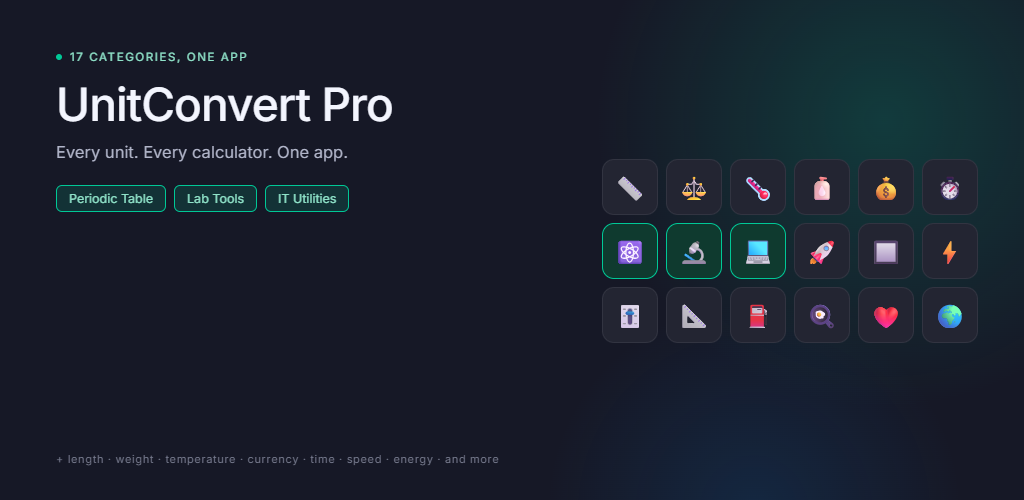

As a biomedical scientist and IT systems lead at an NHS hospital in Liverpool, my days are a whirlwind of neuroimmunology lab work and managing complex pathology IT systems. It’s a delicate balance, but one filled with rewarding challenges. Yet, amidst the tests, analyses, and patient data, I found myself caught in an app overload. One moment, I’d be diligently working on serial dilutions, and the next, I’d be jumping between three separate tools for unit conversions, UUID generation, and mortgage calculations—all while battling incessant ads and unreliable offline access.
Recognizing the inefficiencies, I decided to take matters into my own hands. What started as a simple idea for a converter morphed into a comprehensive app encompassing 17 categories and over 60 calculators, complete with a Periodic Table and even a handy egg timer (because why not?). The journey wasn’t just about coding; it was about defining the scope, embracing the ever-evolving needs of my interdisciplinary work, and ultimately creating a tool that seamlessly integrates into daily tasks. Join me as I explore the trials, triumphs, and unexpected turns of building an all-in-one application designed to simplify the lives of scientists and professionals alike.
It Started With a Simple Problem
UnitConvert Pro started with a problem I kept running into myself: I needed a quick calculation or conversion, but the tools available were either too limited, covered in adverts, required an internet connection, or gave me a number without showing me how they got there.
I wanted something different. One place where I could go from converting a measurement to running a scientific calculation, checking a developer value, or working out something practical without having to search for a different website or app every time.
So I decided to build it myself.
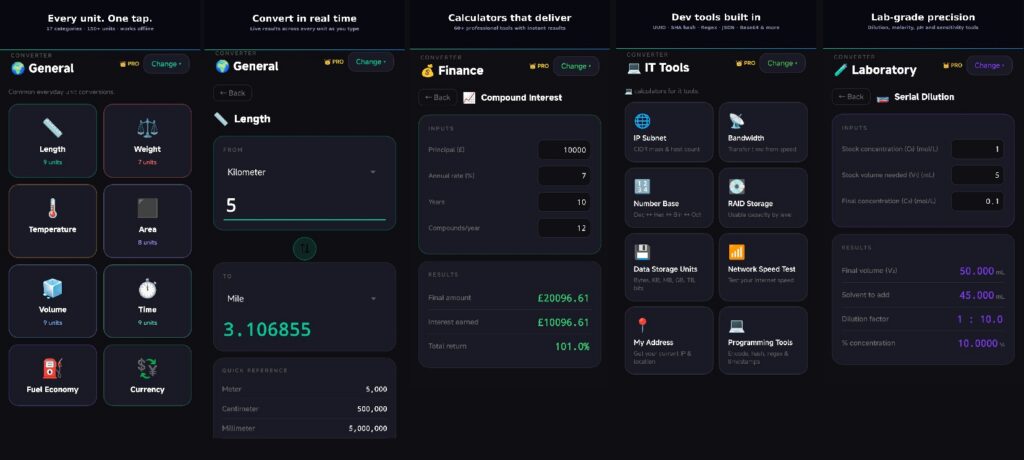
What started as a simple unit converter gradually grew into something much bigger. As I added the tools I actually found useful, more ideas followed. Before long, I had calculators for everything from molarity and serial dilution to mortgage repayments, photography, cooking, automotive calculations, and developer utilities.
Three Months of Evenings and Weekends
The entire app was built solo using React Native and Expo, mostly during evenings and weekends. There wasn’t a big team behind it or a product roadmap handed down from somewhere else — just me, a growing list of things I wanted the app to do, and a lot of time spent figuring out how to make each feature work properly.
That process also shaped how the app feels.
Because I use these tools myself, I tend to notice the small frustrations. If a calculator gives you an answer, I want to know where that answer came from. If I use a conversion regularly, I want it to be easy to find next time. If I’m working somewhere without a connection, I don’t want the app to suddenly become useless.
Those principles became part of the design rather than features added at the end.
More Than 150 Units, 60 Calculators, and Counting
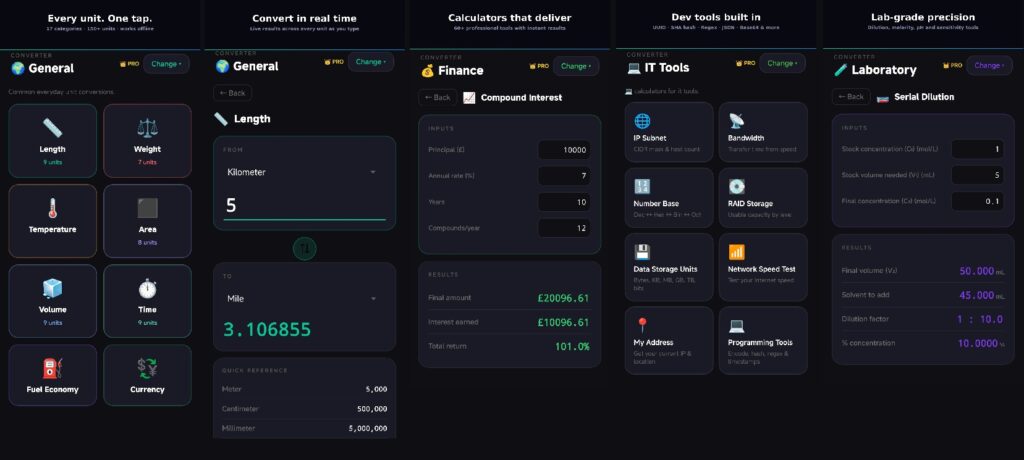
Today, UnitConvert Pro covers 17 categories, from everyday conversions to much more specialised tools. There are over 150 units and more than 60 calculators, alongside developer, science, photography, trade, finance, health, DIY, automotive, music, and astronomy tools.
Some of these tools are things I use regularly. Others exist because I remember thinking, “There should really be a calculator for that.”
I also wanted the app to be useful to people with very different needs. A developer might open it for a UUID or subnet calculator, while a scientist might need molarity or sensitivity and specificity. Someone cooking dinner might be scaling a recipe, while someone working on a DIY project might be calculating paint, flooring, concrete, or roof pitch.
The common thread is simple: you have a number, a question, or a problem, and you want an answer without unnecessary friction.
Why I Built It This Way
One of the biggest decisions I made was to keep the app offline-first. Once installed, the majority of the tools don’t need an internet connection, and your history and favourites stay on your device.
There are no adverts getting in the way, no account you need to create, and no behaviour tracking. I wanted the app to feel like a toolbox that belongs to you rather than a service constantly trying to get something from you.
Even the pricing follows that philosophy. The app is free to use, with an optional £1.99 premium unlock. No subscription, no adverts, and no artificial limitations designed to push you into paying every month.
And I’m Not Finished Yet
Three months of evenings and weekends got UnitConvert Pro to where it is today, but there are still plenty of things I’d like to add.
That’s where I’m hoping users can help shape what comes next. There are thousands of possible calculators, conversions, and specialist tools, and I don’t want to build features simply because they look good on a checklist. I’d rather build things people will actually use.
So if there’s a calculator you find yourself searching for repeatedly, a conversion you wish was easier, or a tool you think would fit nicely into the app, let me know.
UnitConvert Pro started because I wanted a better toolbox for myself. I’m hoping it can become one for you too.
Join our product launch day at Product Hunt: Product Hunt Launch
Play Store: Download UnitConvert Pro